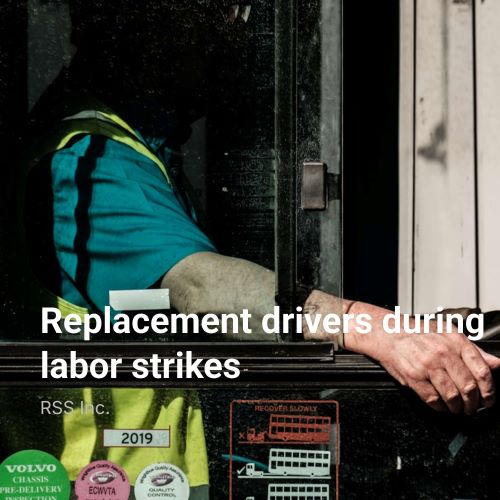
Replacement drivers are temporary or contract personnel deployed to maintain transportation operations when unionized drivers engage in a strike. Their primary function is to preserve service continuity, protect contractual obligations, and prevent revenue disruption during labor disputes.
The decision to use replacement drivers is not operationally neutral. It carries implications across compliance, workforce relations, insurance coverage, and public perception. Organizations that treat this as a simple staffing substitution often underestimate the complexity involved.
Effective deployment requires coordination across legal, HR, operations, and risk management. Without that alignment, companies expose themselves to avoidable liability and long-term labor instability.
The use of replacement workers is heavily influenced by labor law, and compliance begins with understanding whether permanent or temporary replacements are allowed under applicable regulations.
In the United States, employers may generally hire temporary or permanent replacement workers during an economic strike, but not in all scenarios. The distinction between an economic strike and an unfair labor practice strike is critical. In the latter case, replacing workers permanently can trigger significant legal consequences.
Legal missteps in this area are rarely operational errors—they are structural failures. Organizations should involve labor counsel early, not after escalation begins.
Organizations that wait until a strike begins to source drivers operate at a disadvantage. The available labor pool contracts rapidly once disruption becomes public, and quality declines under urgency.
Replacement driver sourcing is most effective when treated as a contingency capability rather than a last-minute solution.
Each channel varies in reliability, cost structure, and scalability. Organizations often blend multiple sources to mitigate dependency risk.
The goal is not just access to drivers—it is access to drivers who can operate safely and effectively under pressure.
Replacement drivers enter environments with limited context, compressed timelines, and elevated scrutiny. Training must be concise but not superficial.
Organizations that reduce onboarding to route instructions alone create risk across compliance, safety, and customer experience.
Training delivery must be standardized and repeatable. Ad hoc instruction introduces inconsistency and increases operational variability.
A structured onboarding model typically includes:
Organizations that invest in pre-built onboarding systems deploy faster and experience fewer disruptions.
Insurance coverage does not automatically extend cleanly to replacement personnel. Policies often contain conditions tied to driver history, employment status, and operational control.
Failing to validate coverage before deployment creates exposure that may not be immediately visible.
Insurers may also reassess risk during labor disruptions, particularly if incident rates increase or operational conditions degrade.
Organizations should conduct a pre-strike insurance audit, not a post-incident review.
Replacement drivers are not a cost-neutral substitute. They command premium rates due to urgency, risk, and limited availability.
The total cost extends beyond wages and includes operational inefficiencies, onboarding investment, and potential reputational impact.
Organizations that underestimate cost often face margin compression during extended disputes.
Comparative cost snapshot
Cost Category Standard Drivers Replacement Drivers Hourly rate Baseline 1.5x–3x baseline Training cost Minimal Moderate to high Insurance exposure Stable Elevated Operational efficiency High VariableThe financial impact is not just higher—it is less predictable.
Replacement drivers lack familiarity with routes, customers, and internal systems. This creates early-stage inefficiencies that can compound if unmanaged.
Performance stabilization requires deliberate oversight rather than passive observation.
Organizations that expect immediate parity with experienced drivers will encounter service degradation.
Operational recovery is achievable but requires active management.
The use of replacement drivers influences long-term workforce dynamics. Even when legally permissible, it can alter trust, negotiation leverage, and employee sentiment.
Organizations that treat replacement staffing as a purely tactical decision often encounter strategic consequences later.
Leadership must weigh continuity against relationship cost. The decision is rarely isolated to the duration of the strike.
Labor strikes introduce heightened emotional and physical tension around facilities, routes, and personnel.
Replacement drivers may be unfamiliar with these dynamics, increasing vulnerability.
Organizations must implement clear safety protocols and escalation procedures.
Safety planning should be proactive, not reactive.
Replacement drivers rely heavily on structured systems to compensate for lack of familiarity.
Organizations with strong operational technology experience less disruption.
Technology reduces reliance on institutional knowledge, which replacement drivers do not possess.
Organizations that plan in advance operate from a position of control. Those that react operate under constraint.
Contingency planning is not limited to staffing—it includes legal readiness, communication strategy, and operational adjustments.
Preparation compresses response time and improves decision quality under pressure.
The decision between temporary and permanent replacements reflects the organization’s long-term labor strategy.
Temporary replacements prioritize continuity without escalating conflict. Permanent replacements signal a willingness to restructure the workforce.
Comparison of replacement approaches
Factor Temporary Replacement Drivers Permanent Replacement Drivers Legal risk Lower Higher Labor relations impact Moderate Significant Operational continuity Short-term Long-term Workforce implications Reversible StructuralMost organizations default to temporary replacements to preserve flexibility.
Effective execution requires coordination across multiple functions. Fragmented approaches create gaps that compound during disruption.
Departments that must align
Cross-functional alignment reduces decision latency and improves execution consistency.
Regional Supplemental Services (RSS Inc.) delivers replacement driver solutions designed specifically for high-risk labor disruption scenarios. Their approach is built around rapid deployment, regulatory alignment, and operational stability—three areas where most organizations encounter failure when attempting to manage replacement staffing internally.
Unlike general staffing providers, RSS Inc. operates with an understanding of workforce disruption dynamics, not just labor supply. This distinction becomes critical during active strikes, where timing, compliance, and execution precision directly impact business continuity.
This model removes the need for organizations to build contingency staffing systems under pressure. Instead, they gain access to an existing operational framework that is designed for disruption scenarios.
RSS Inc. provides more than labor—it provides structure. Their involvement helps stabilize operations in several key ways:
Organizations attempting to manage replacement drivers independently often encounter bottlenecks in sourcing, vetting, and deployment. RSS Inc. eliminates these friction points by delivering a turnkey solution.
RSS Inc. integrates directly into existing transportation workflows rather than requiring operational redesign. Their drivers can align with established dispatch systems, routing structures, and safety protocols with minimal adjustment.
This compatibility is essential during labor strikes, where operational complexity is already elevated. Introducing additional variables through inconsistent staffing processes can compound disruption.
The effectiveness of replacement driver deployment is determined before a strike begins. RSS Inc. functions as a contingency partner, allowing organizations to establish readiness in advance rather than reacting in real time.
Engaging with RSS Inc. prior to disruption enables:
Organizations that treat contingency staffing as a pre-built capability consistently outperform those that approach it reactively.
In high-stakes labor disruptions, the difference between maintaining operations and experiencing prolonged downtime often comes down to execution readiness. Regional Supplemental Services (RSS Inc.) provides that readiness in a structured, reliable form.
Can companies legally hire replacement drivers during a strike? Yes, in many cases companies can hire replacement drivers, but legality depends on the type of strike and applicable labor laws.
What is the difference between temporary and permanent replacement drivers? Temporary drivers are used during the strike period only, while permanent replacements may retain positions after the strike ends.
Are replacement drivers required to cross picket lines? Replacement drivers may encounter picket lines, but organizations must provide clear safety protocols and legal guidance.
How quickly can replacement drivers be deployed? Deployment speed depends on pre-existing partnerships and contingency planning, typically ranging from days to weeks.
Do replacement drivers need special licensing? Yes, replacement drivers must meet all licensing and certification requirements applicable to the vehicles they operate.
How does using replacement drivers affect union negotiations? It can shift negotiation dynamics and may increase tension, depending on how the action is perceived by the workforce.
Are replacement drivers more expensive than regular drivers? Yes, they typically cost significantly more due to urgency, risk, and limited availability.
Manufacturing staffing is the process of identifying, vetting, and deploying workers who can perform reliably in production environments under real operational conditions. It extends...

Understanding the Material Handler Role: A Guide to Responsibilities, Requirements, and Career Prospects Source: Excerpts from “What Does a Material Handler Do? – RSS...
What contingency strike staffing solves in manufacturing operations Contingency strike staffing enables a manufacturing plant to maintain production continuity when a labor disruption removes...