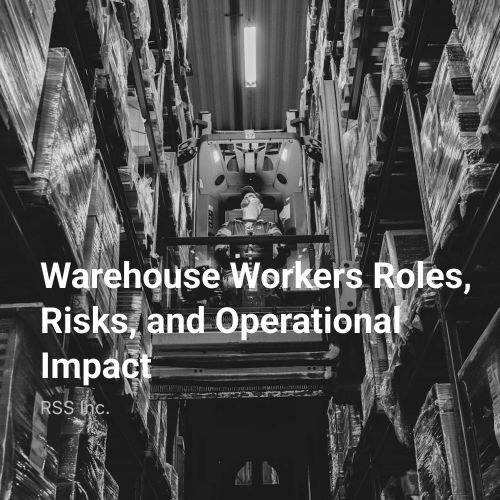
A complete guide to how warehouse workers function within modern logistics, covering responsibilities, productivity, safety, automation, and performance measurement.
Warehouse workers are the operational backbone of logistics environments, responsible for physically moving, tracking, and preparing goods for distribution within controlled storage systems. The role encompasses a broad set of tasks that connect inbound receiving, internal storage, and outbound fulfillment into a continuous workflow.
The scope extends beyond manual labor. Warehouse workers interact with inventory management systems, scanning technology, routing protocols, and performance metrics that determine throughput and accuracy. In high-volume facilities, even small inefficiencies at the worker level cascade into measurable delays across transportation and delivery networks.
The modern warehouse worker operates within a system designed for precision. Every movement — whether scanning a barcode, staging a pallet, or confirming a pick — contributes to data integrity and operational visibility.
Warehouse workers execute a structured sequence of tasks that ensure goods flow accurately and efficiently through the facility. These responsibilities vary by warehouse type but consistently align with three core operational phases: receiving, storage, and fulfillment.
1ReceivingInspect & Log 2PlacementStore & Organize 3Pick & PackFulfill Orders 4ShippingDispatch 5AuditingVerify & Adjust continuous cycle Figure 1: The five operational phases of warehouse worker responsibilities form a continuous cycle.These responsibilities operate within defined performance benchmarks, including pick rates, error rates, and turnaround times.
Warehouse environments vary significantly, and worker responsibilities adjust based on the operational model and inventory characteristics.
Each environment imposes different physical, procedural, and compliance demands on warehouse workers.
Warehouse productivity is determined at the worker level through movement efficiency, task sequencing, and system interaction. Small inefficiencies — such as unnecessary travel distance or scanning delays — scale across shifts and teams, impacting overall throughput.
Worker Output Travel Path Reduce walking distance Task Batching Group similar orders Real-Time Data Inventory visibility Ergonomic Design Reduce physical strain Standardized Procedures Figure 2: Five interconnected drivers that determine warehouse worker output.Operational leaders often measure worker output through metrics such as units picked per hour, order accuracy rates, and time-to-ship performance.
Warehouse environments present a combination of predictable hazards and situational risks that require active management.
Falling Objects & Structural Improper stacking, rack instability Equipment Interaction Forklift collisions, mechanical failure Environmental Conditions Slippery floors, temperature extremes Human Error Under Pressure Peak-period mistakes, fatigue Material Handling Risks Most common: lifting injuries, repetitive strain Severity Frequency Figure 3: Warehouse safety risks ranked from most frequent (base) to most severe (peak).Risk mitigation depends on structured training, clear protocols, and consistent enforcement of safety standards.
Automation shifts warehouse worker responsibilities from purely manual execution to hybrid operational roles involving oversight and system interaction. Technologies such as autonomous mobile robots (AMRs), conveyor systems, and automated storage and retrieval systems (AS/RS) redefine task distribution.
TRADITIONAL Manual Execution Physical Effort → Manual Picking Walk, lift, scan High strain · Variable speed automation AUTOMATED Oversight & Hybrid Roles System Oversight + AMRs / AS/RS Auto-Sorting Less strain · Tech literacy required Figure 4: Automation augments rather than replaces the warehouse worker — the role shifts from physical labor toward technical oversight.Automation reduces physical strain but increases the need for technical literacy and system awareness.
High turnover among warehouse workers introduces variability in performance, increases training costs, and disrupts workflow continuity. Stability within the workforce correlates directly with operational reliability.
Facilities that prioritize retention typically achieve higher accuracy rates and reduced error margins over time.
Warehouse workers operate within interconnected systems that guide, track, and validate their actions. These systems form the operational infrastructure of modern logistics environments.
The effectiveness of warehouse workers is closely tied to the usability and reliability of these systems.
Warehouse worker performance is not solely determined by effort or skill. Structural constraints often define the upper limits of output.
Addressing these constraints typically yields greater performance gains than increasing worker intensity alone.
Performance measurement in warehouse environments relies on clearly defined metrics that reflect both efficiency and accuracy.
PICK RATE 120 items / hour Throughput ORDER ACCURACY 99.5% correct orders Customer Satisfaction CYCLE TIME 4.2h order to ship Delivery Speed INVENTORY ACCURACY 98% system vs physical Planning Reliability LABOR UTILIZATION 85% productive time Cost Efficiency WAREHOUSE WORKER PERFORMANCE DASHBOARD Figure 5: Illustrative dashboard of the five core warehouse worker performance metrics. Sample values shown.These metrics provide visibility into both individual and system-level performance.
Warehouse workers are often grouped with broader logistics roles, but distinctions exist in scope and responsibility.
Understanding these distinctions clarifies role expectations and operational dependencies.
Operational decisions involving warehouse workers must balance output demands with long-term sustainability. Overemphasis on short-term productivity often leads to increased errors, injuries, and turnover.
Effective management aligns these factors with overall supply chain objectives.
Warehouse workers handle receiving, storing, picking, packing, and shipping goods within a structured facility.
Are warehouse workers considered skilled labor?Warehouse workers require operational, technical, and procedural skills, particularly in technology-enabled environments.
How are warehouse workers evaluated?Performance is measured through metrics such as pick rate, accuracy, and cycle time.
Do warehouse workers operate machinery?Many warehouse workers use equipment such as forklifts, pallet jacks, and scanning devices, depending on role specialization.
How has technology changed warehouse workers' roles?Technology has shifted responsibilities toward system interaction, data validation, and oversight of automated processes.
What risks do warehouse workers face?Common risks include physical strain, equipment accidents, environmental hazards, and errors under pressure.
What industries rely most on warehouse workers?Retail, manufacturing, e-commerce, food distribution, and healthcare logistics all depend heavily on warehouse workers.
Warehouse workers remain central to logistics execution even as automation expands and systems become more sophisticated. The role is increasingly defined by precision, adaptability, and interaction with technology rather than purely physical output. Organizations that align worker capabilities with system design will determine the next phase of operational performance.

Understanding the Material Handler Role: A Guide to Responsibilities, Requirements, and Career Prospects Source: Excerpts from “What Does a Material Handler Do? – RSS...
Replacement drivers during labor strikes keep operations running but pose legal and reputational risks. Replacement drivers are temporary or contract personnel deployed to maintain...
Understanding the Logic Behind Ratios That Keep Workflows Stable In the modern industrial, logistics, and service environments, coverage waves—the strategic scheduling of supervisory oversight—have...